Table of Contents
If there’s one lesson I wish I had learned earlier in my training, it’s that breath is the true foundation of strength. I used to think that strength came purely from muscle size, hard work, and heavier weights. I’d grind through sets, chase personal records, and still feel like something was missing. My lifts plateaued, my core often felt unstable, and I’d walk away feeling drained instead of strong.
That changed when I discovered how much breathing influences performance, especially for women. Once I started understanding the connection between my breath, my posture, and my power output, everything shifted. Suddenly, my lifts felt smoother, my core stronger, and my recovery faster.
Most women underestimate the role of breathing in strength training. We focus on the physical side, our reps, form, and nutrition, but the way we breathe determines how much of our actual power potential we’re using. Proper breath control builds internal pressure, stabilizes your body, and turns every lift into a coordinated act of power.
The Missing Link Between Breath and Female Strength Output
For years, I thought my inconsistent performance was due to lack of training or fatigue. But the truth was, my breathing habits were holding me back. The more I worked with female clients, the more I realized this pattern was universal.
Women’s bodies naturally have different rib structures, pelvic angles, and hormonal fluctuations that affect breathing patterns. Many of us are chronic chest breathers without realizing it, taking shallow breaths that keep us from using our diaphragm effectively. When we train that way, we can’t build the internal stability our bodies need for strength.
This is where the breathing stack comes in. It’s a method of aligning your ribs, diaphragm, and pelvis to generate intra abdominal pressure. That pressure acts as an internal brace for your spine, letting you lift heavier without straining your back or losing form.
Without this alignment, energy leaks out through the weakest points of your posture. You might feel strong, but you’ll never hit your true output potential. When I started using the breathing stack consistently, I felt the difference immediately. It was like flipping a switch from struggle to flow.
My Experience with Breathing and Power Training
I used to approach the gym with one mindset: push harder. I believed that if I wasn’t dripping sweat or sore for days, I wasn’t training effectively. But during one particularly tough session of squats, I noticed something. My form was perfect, but I couldn’t stabilize my core under heavier weight. My back tensed, my knees wobbled, and I lost confidence mid rep.
My coach pointed out that I wasn’t breathing properly. He explained that my chest breathing pattern was limiting my power. Instead, he taught me how to breathe into my diaphragm and stack my breath.
It felt strange at first, like learning to breathe all over again, but once I nailed it, my next squat felt completely different. My body felt locked in, powerful, and grounded. The lift felt almost effortless. That single change improved my output more than months of regular training ever did.
Now, every time I train or coach women, breathwork comes first. It’s not just about oxygen, it’s about control. When you control your breath, you control your energy, stability, and strength.
What the Breathing Stack Actually Is
The breathing stack is a coordination of three key elements, your diaphragm, ribs, and pelvic floor. Together, these structures form the core canister that stabilizes your spine during training. When aligned and activated properly, they create intra abdominal pressure that allows your muscles to transmit force safely and effectively.
Here’s what it looks like in practice:
- Stack your ribs over your pelvis: Imagine your ribs as a bowl sitting on top of your pelvis. When your posture is aligned, that bowl is balanced, not tipping forward or back.
- Inhale through your diaphragm: Instead of lifting your shoulders, breathe into your lower ribs and belly. You should feel expansion around your waist, not just your chest.
- Brace your core: Before lifting, tighten your midsection as if preparing to take a gentle punch. This isn’t sucking in, it’s creating tension and pressure.
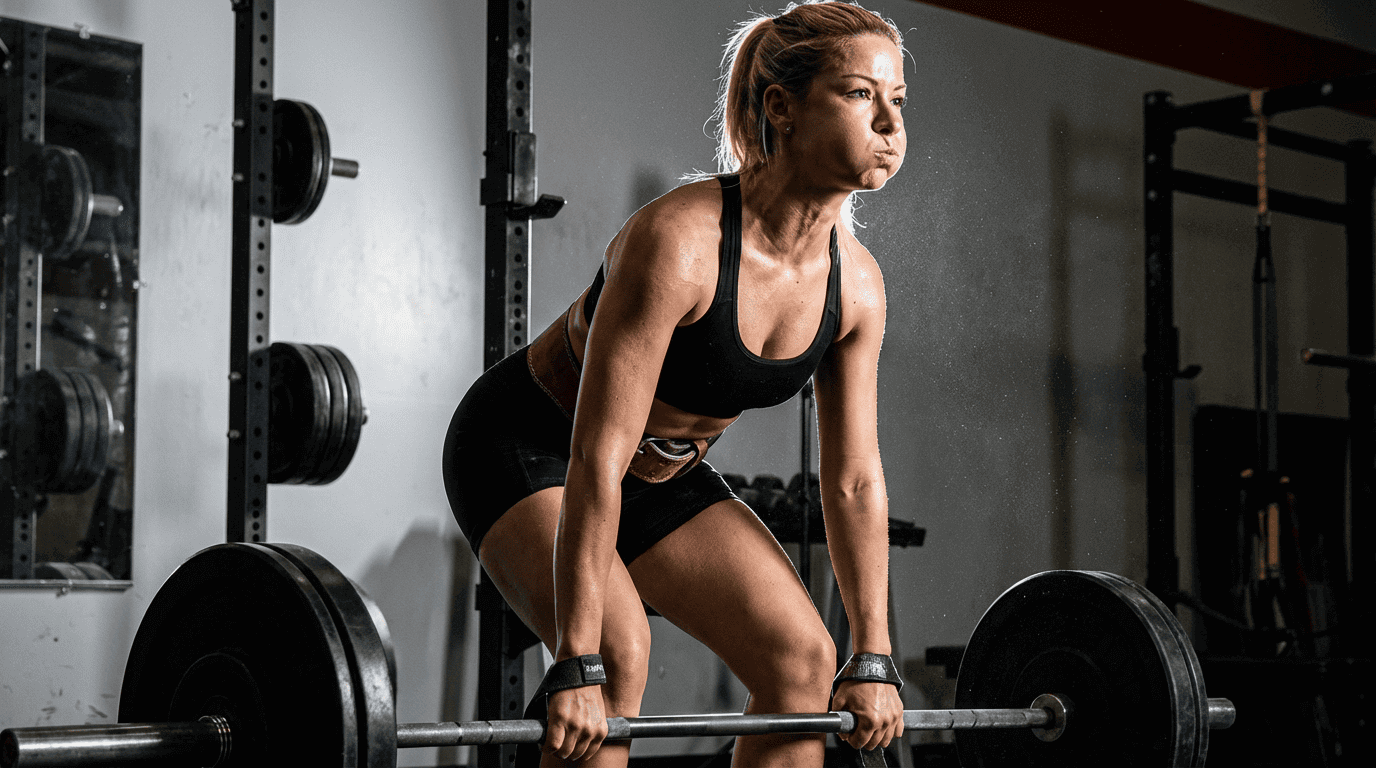
- Hold the breath during exertion: Maintain that pressure as you lift or push. This stabilizes your spine and maximizes your power output.
- Exhale with control: Once the hardest part of the lift is complete, exhale slowly to maintain tension while releasing excess pressure.
This breathing stack doesn’t just make you stronger, it keeps you safe. It prevents your lower back from overworking and reduces the risk of pelvic strain, something many women don’t realize they’re at risk for during heavy lifting.
Step by-Step Guide to Using the Breathing Stack in Your Training
Here’s exactly how I apply the breathing stack in my own workouts:
Step 1: Find your alignment
Stand tall and roll your shoulders back. Check that your ribs aren’t flaring forward and your pelvis isn’t tilting backward. Imagine stacking your ribcage directly above your hips.
Step 2: Inhale deeply through your nose
Take a slow breath into your lower belly. Feel your sides and back expand. This kind of breathing engages your diaphragm fully, setting the stage for a powerful brace.
Step 3: Create tension
Before lifting, tighten your core as if preparing for resistance. Keep the tension firm but natural, avoid over-squeezing or holding your breath too long.
Step 4: Lift with control
As you move through the lift, maintain that intra-abdominal pressure. If you lose it, your core will give out, and your body will compensate with less efficient movement.
Step 5: Exhale with purpose
As you complete the rep, slowly release your breath. The key is to stay controlled so you don’t lose tension prematurely.
When you master this rhythm, you’ll find that every lift feels stronger and more stable. Even lighter weights start to feel more effective because you’re finally using your body’s natural mechanics.
Common Mistakes Women Make When Breathing During Lifts
I see these three mistakes in nearly every training session with women new to breathing work:
- Chest breathing instead of diaphragmatic breathing. When your breath stays shallow, your ribs lift and your core disengages. You lose stability immediately.
- Over-bracing. Some women overcorrect and clench their abs too tightly, creating tension without mobility. This can make it hard to breathe and cause early fatigue.
- Losing alignment under fatigue. Once exhaustion kicks in, ribs flare and hips tilt, breaking the breathing stack and making your lifts weaker and riskier.
It takes time to build the habit of proper breathing, but once you do, your form, power, and endurance will all improve. The breathing stack is a skill. It’s not something you master overnight, but the payoff is worth it.
How the Breathing Stack Improves Core Strength and Stability
One of the biggest misconceptions about core strength is that it’s built through endless crunches or ab workouts. True core strength comes from learning how to manage pressure inside your body. That’s what the breathing stack trains you to do.
By aligning your diaphragm and pelvic floor, you activate the deep stabilizing muscles that protect your spine. These include the transverse abdominis and the multifidus, muscles that most traditional ab workouts miss. When these deep muscles engage correctly, they create a natural brace that keeps your body stable during lifts.
This technique also benefits your pelvic health. Many women experience pelvic floor issues after childbirth or from years of high-intensity training without proper bracing. By learning to breathe correctly, you reduce downward pressure and keep your pelvic floor supported instead of strained.
Adapting the Technique for Your Cycle and Energy Levels
Breathing patterns can shift slightly depending on where you are in your menstrual cycle. Hormonal changes affect your lung capacity, energy, and even how your body responds to stress.
During the follicular phase, after your period and leading up to ovulation, your estrogen levels rise, improving your stamina and oxygen efficiency. This is the perfect time to focus on heavier lifts and stronger bracing.
During the luteal phase, after ovulation, progesterone increases and can make breathing feel shallower. This is when I recommend slowing things down. Focus on breath control, moderate loads, and recovery. Practicing longer exhales and slower bracing drills can help balance your energy.
Syncing your breathing stack with your cycle creates a rhythm that honors your body’s natural variations in power and endurance. It’s about training smarter, not just harder.
FAQs
What is the best breathing technique for strength training as a woman?
The best technique is the breathing stack, inhaling through your diaphragm, bracing your core, and exhaling with control to maintain intra-abdominal pressure.
Why does breathing control improve strength output for women?
It stabilizes your spine, engages deep core muscles, and allows you to transfer force more efficiently. Proper breathing directly increases both power and safety.
Can I use the breathing stack for all types of workouts?
Yes. Use stronger bracing for lifts like squats or deadlifts and softer control for movements like yoga or mobility work. It can be applied to any fitness level or activity.
Final Thoughts
Breathwork has become the cornerstone of my training. When I first started focusing on my breathing stack, I was shocked at how much power I had been leaving untapped. My lifts got stronger, my recovery improved, and my connection to my body deepened in a way that no amount of repetition ever could.
What I love most about the breathing stack is how it brings presence into your workouts. You stop rushing through movements and start feeling them, every rep, every inhale, every release. It transforms training from something mechanical into something deeply intuitive.
For women, learning to use the breath isn’t just about performance. It’s about stability, confidence, and control. It’s about knowing your body well enough to push when you can and breathe when you need to.
So the next time you step into the gym, don’t just focus on lifting heavier. Focus on stacking your breath, aligning your body, and feeling your strength from the inside out. That’s where real power begins.