Table of Contents
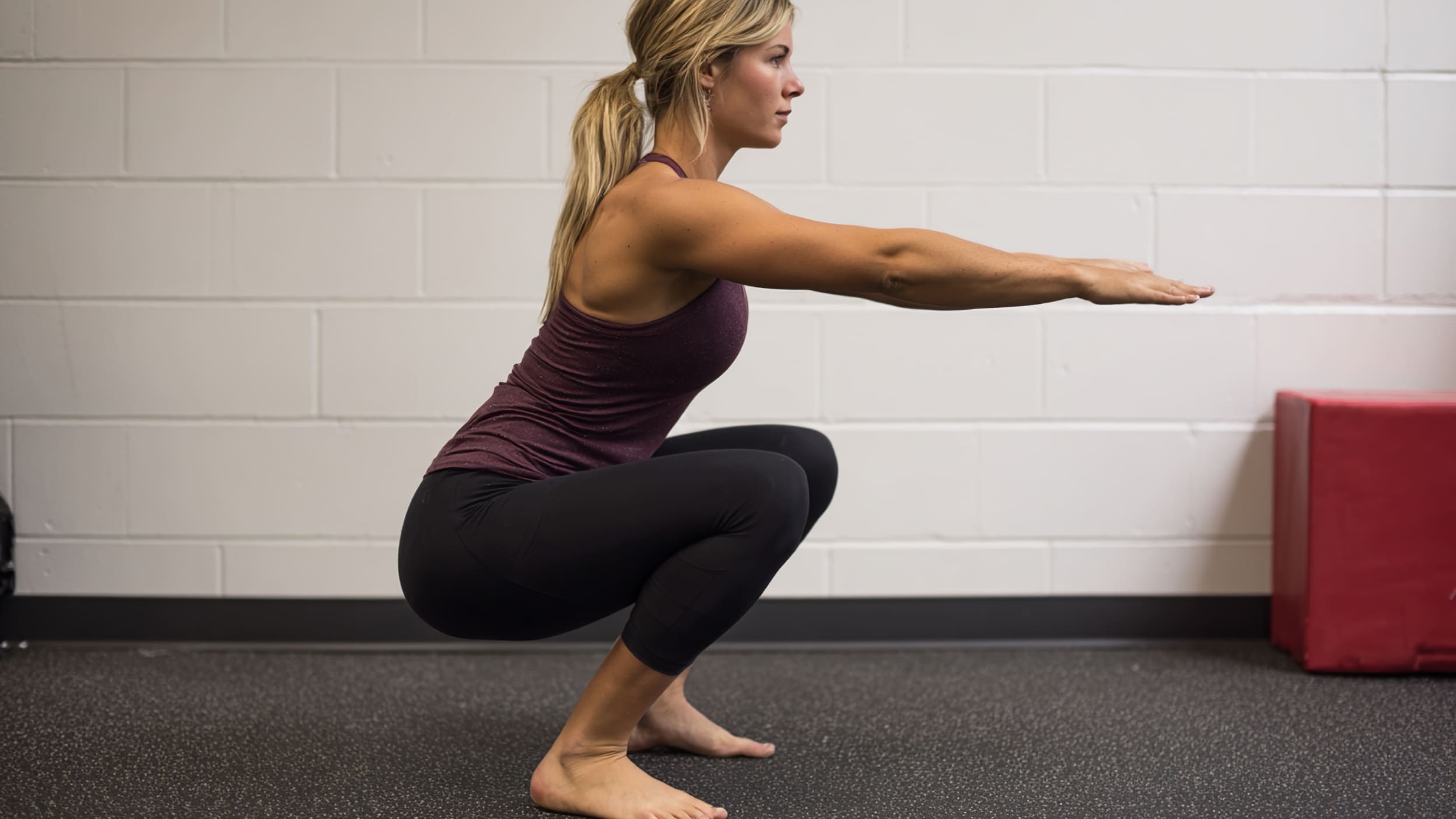
If there’s one movement I’ve seen women struggle with again and again, it’s the squat. It looks simple on the surface, but under the bar, so many things can go wrong, especially with the knees. That little inward shift, the one you might brush off as “just my stance,” can become a long-term problem if ignored.
When I first started coaching, I thought proper knee alignment was just about strength. Over time, I learned it’s much more about awareness and connection to your movement. Most women don’t realize how much their unique anatomy plays into squat form.
Our hips tend to be wider, and that changes how our femurs angle toward the knees. Hormonal fluctuations can also affect ligament stability, which means some days we feel stronger and more coordinated than others. Once I understood that, I stopped trying to force a textbook squat form and started working with my body instead.
When your knees track properly, your squat becomes safer, stronger, and more efficient. You move from surviving reps to feeling stable and powerful through every inch of the lift.
What Really Causes Knee Cave During Squats
When women tell me their knees cave in, the first thing I ask is what they feel during the lift. Nine times out of ten, they say their glutes aren’t firing or their ankles feel tight. That’s a big clue.
Knee cave usually isn’t about one weak muscle. It’s about how your body distributes load and recruits the right stabilizers.
Here are the most common reasons I see this happen:
- Weak glute medius or external rotators: These small hip muscles control outward rotation and keep the knees in line.
- Tight adductors: Overactive inner thighs can pull the knees inward when descending.
- Poor ankle mobility: If your ankles can’t flex enough, your knees compensate by moving inward.
- Lack of foot control: Most women don’t engage the arches or outer edges of their feet during squats.
- Going too heavy too soon: Pushing past your strength threshold forces your knees to compensate for lack of control.
When I started fixing this in my own training, I was shocked at how much it improved everything else. My squats felt smoother, my hips opened up, and my knees stopped aching after leg days. It’s amazing how much difference one small alignment change can make.
The Right Squat Setup for Female Anatomy
Women’s hip sockets and leg proportions vary widely, which is why copying someone else’s squat form can be frustrating. What feels natural for one woman may feel painful for another. Finding your ideal stance is about understanding your body, not forcing it into someone else’s mold.
Here’s a quick guide I use with my clients:
| Body Type or Mobility | Ideal Stance | Notes |
| Wider hips | Slightly wider than shoulder-width | Allows natural femur rotation |
| Narrow hips | Hip-width stance | Easier for upright torso control |
| Tight ankles | Heels elevated on plates | Supports knee travel without collapse |
| Limited hip mobility | Slight toe-out (15–30°) | Helps prevent inward knee drift |
Once you find the right stance, anchor your feet into the floor. I like to think of it as rooting down. I tell my clients to grip the ground with their big toes, little toes, and heels equally. When you press into the floor this way, your knees naturally align over your toes.
Filming yourself helps too. The first time I saw a slown motion replay of my knees caving in, it was a wake-up call. Video doesn’t lie. It shows what you can’t always feel.
How to Fix Knee Tracking Step by Step
When I rebuild squat patterns with clients, we always start with awareness before adding weight. You can’t correct what you can’t feel.
Here’s the exact progression I use:
Step 1: Bodyweight control
Start with bodyweight squats in front of a mirror. Watch that your knees follow the same path as your toes throughout the movement.
Step 2: Add tempo and pause
Slow down your descent to three seconds and pause for one second at the bottom. This helps your muscles fire in the right order and builds control through the full range.
Step 3: Add a resistance band
Place a small loop band just above your knees. As you squat, gently push your knees outward against the band. It trains the glutes to stay engaged.
Step 4: Reinforce under light load
When your bodyweight squat feels consistent, add a goblet squat or light barbell. Focus on the same control and cues.
Step 5: Strengthen supporting muscles
Incorporate accessory work like clamshells, hip thrusts, and step-ups into your program.
When I followed this process myself, my squat form finally clicked. I could feel my glutes supporting every rep. My knees tracked perfectly, even under heavy load. It took a few weeks of focused training, but the payoff was massive.
Strengthening the Right Muscles for Knee Safety
The key to fixing knee tracking is strengthening the muscles that stabilize the hips and knees. When those muscles do their job, the rest of your movement falls into place naturally.
Here are the most effective exercises I use:
| Exercise | Purpose | Sets/Reps |
| Glute bridges or hip thrusts | Strengthen glute max and medius | 3×10–15 |
| Lateral band walks | Improve lateral hip stability | 3×15 each direction |
| Bulgarian split squats | Enhance single-leg control | 3×8–10 each leg |
| Step-ups | Reinforce proper knee tracking | 3×10 each leg |
| Hamstring curls | Strengthen posterior chain | 3×12–15 |
| Wall sits with mini band | Maintain knee alignment under tension | 3×30 seconds |
When I started combining these with regular squats, my lower body felt more balanced. I could tell that my knees weren’t drifting anymore because the movement finally felt solid from the ground up. These small stabilizing exercises are the foundation of strong, pain-free lifts.
Female-Friendly Cues That Actually Work
Cues make or break your form. The right ones connect your brain to your muscles and make good movement automatic.
Here are the cues that have worked best in my experience:
- “Push the floor apart.” It instantly activates your glutes and keeps knees aligned.
- “Knees follow your middle toes.” Keeps everything visually in line.
- “Stay grounded through your feet.” Prevents ankle collapse or heel lift.
- “Brace your core before you move.” A stable core supports stable knees.
- “Lead with your hips, not your knees.” Helps prevent excessive forward knee travel.
I once tried to overcomplicate my cues with technical anatomy terms. It never stuck. When I switched to simple, body-focused language, my clients made progress faster. Sometimes, feeling the movement matters more than analyzing it.
Common Mistakes That Make Knee Pain Worse
Over the years, I’ve seen women unintentionally make their knee issues worse by chasing progress instead of precision.
Here are the big mistakes to avoid:
- Skipping the warm-up. Tight hips and cold muscles make misalignment inevitable.
- Adding load too quickly. Your nervous system needs time to adapt to new mechanics.
- Neglecting the core. A weak core lets your lower body compensate in unhealthy ways.
- Letting fatigue ruin form. The last reps count the most for reinforcing good movement.
- Using knee sleeves as a crutch. They support warmth, not stability.
- Ignoring pain signals. Pain means something is off. Listen to it.
I made nearly every one of these mistakes when I started lifting. I was eager to go heavier and ignored the small aches until they became real setbacks. Slowing down and fixing my foundation changed everything.
Real-Life Case: Rebuilding Squat Form from the Ground Up
One of my clients, Mia, came to me convinced she had bad knees. Every squat session left her sore, frustrated, and questioning whether squats were even safe for her.
I watched her squat during our first session. Her form looked fine at first, but as soon as she hit depth, her knees collapsed inward and her heels lifted slightly. I recognized it immediately weak glutes and tight ankles.
We stripped her training back to basics. For two weeks, we focused on mobility and glute activation drills. Then, we rebuilt her squat pattern with a mini band and bodyweight practice. By the fourth week, she could squat to full depth with perfect alignment.
Two months later, Mia hit a new PR and told me her knees had never felt better. The biggest win wasn’t the weight; it was the confidence she gained knowing she was in control of her movement.
I’ve seen this story repeat over and over. The moment women understand how to align their knees and hips, their entire lower body strength transforms.
FAQs
Why do my knees cave in when I squat?
It usually comes from weak glutes, tight inner thighs, or restricted ankle mobility. Focus on hip and glute strengthening and proper stance width.
What’s the safest squat form for women?
A stance that allows your knees to track directly over your toes, heels grounded, chest lifted, and core engaged. Your stance width may vary based on your hips.
Are squats bad for women’s knees?
Not when done correctly. Squats strengthen the knees by building the surrounding muscles and improving joint stability. Pain usually signals poor form, not the movement itself.
Final Thoughts
Squats are one of the best movements for building strength, confidence, and athletic power, but they demand respect. Your knees aren’t weak. They’re responsive. They reflect how well your hips, feet, and core are working together.
In my own journey, fixing knee tracking taught me more about movement than any certification ever could. It reminded me that strength training isn’t about perfection. It’s about awareness and intention.
When you squat with control, you feel the difference. The movement feels smoother, stronger, and more natural. You stop worrying about injury and start focusing on growth.
So the next time you hit the gym, pay attention to how your knees move. Small adjustments lead to big changes, and those changes will keep you lifting safely for years to come.
When your knees track correctly, everything else falls into place. Your confidence grows, your strength multiplies, and your workouts stop feeling like work. They become a celebration of what your body can truly do.