Table of Contents
I’ll be honest – for the first three years of my fitness journey, I was a cardio queen who thought more was always better. I’d spend 45 minutes on the elliptical, thinking I was crushing my goals, while secretly wondering why I wasn’t seeing the results I wanted. It wasn’t until I discovered the world beyond steady-state cardio that everything changed.
If you’ve ever stood in your gym, torn between jumping on the treadmill for a long run or heading to the weights area for a quick, intense circuit, you’re not alone. The debate between High-Intensity Interval Training (HIIT) and Low-Intensity Steady State (LISS) cardio has been raging for years, and honestly, both sides have valid points.
As women, we’re often bombarded with conflicting advice about which type of cardio will help us reach our goals faster. Today, I’m breaking down the science, sharing what I’ve learned through trial and error, and helping you figure out which approach – or combination – might work best for your body and lifestyle.
Understanding HIIT: The Power of Intensity
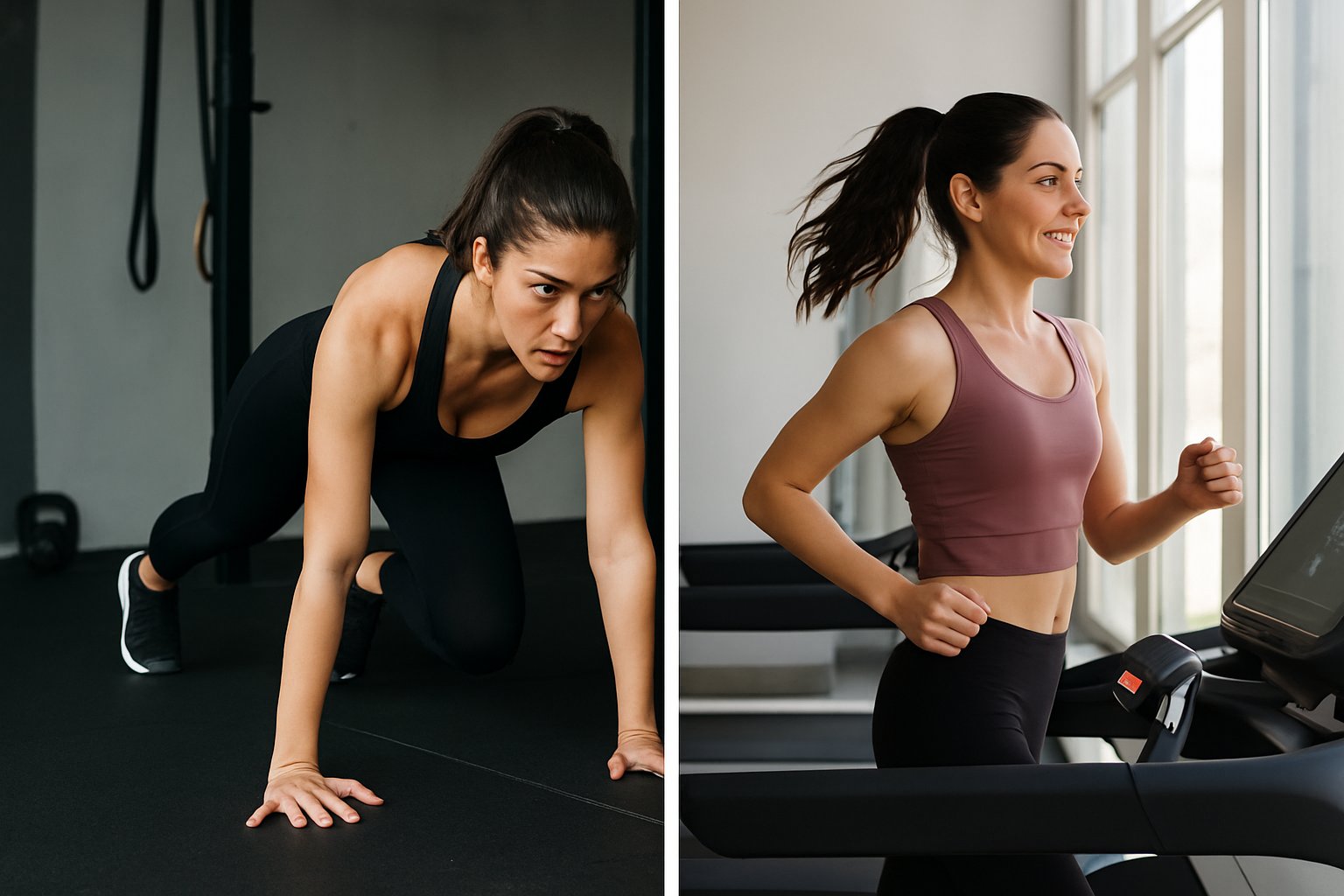
High-Intensity Interval Training alternates between short bursts of intense effort and brief recovery periods. Think 30 seconds of all-out sprints followed by 90 seconds of walking, repeated for 15-20 minutes total.
My first real HIIT experience was eye-opening. I remember thinking, “There’s no way 20 minutes can be harder than my usual hour-long sessions.” I was wrong – and gloriously exhausted after just 15 minutes of alternating between burpees and mountain climbers.
The HIIT Advantage:
HIIT’s biggest claim to fame is the “afterburn effect” or EPOC (Excess Post-Exercise Oxygen Consumption). Your body continues burning calories at an elevated rate for hours after your workout ends. Research shows this can increase your metabolic rate by 6-15% for up to 14 hours post-workout.
For women juggling demanding schedules, HIIT’s time efficiency is game-changing. A 20-minute HIIT session can burn as many calories as 40-50 minutes of moderate steady-state cardio. Plus, HIIT has been shown to be particularly effective at reducing visceral fat – the stubborn belly fat that many of us struggle with.
HIIT also preserves muscle mass better than traditional cardio. When I was doing only LISS, I noticed I was losing muscle along with fat. Once I incorporated HIIT, my body composition improved dramatically – I was getting leaner while maintaining the muscle I’d worked so hard to build.
The HIIT Challenges:
But let’s talk reality – HIIT is intense, and recovery is crucial. I learned this the hard way when I tried doing HIIT six days a week and found myself constantly exhausted, irritable, and eventually injured. Your central nervous system needs time to recover from truly high-intensity efforts.
HIIT can also be intimidating for beginners. The intensity can feel overwhelming, and proper form becomes more challenging when you’re pushing your limits. I’ve seen too many women get discouraged because they jumped into advanced HIIT workouts before building a solid fitness foundation.
Understanding LISS: The Steady Path Forward
Low-Intensity Steady State cardio maintains a consistent, moderate pace for extended periods. This includes activities like brisk walking, easy cycling, swimming, or that elliptical session I used to love so much.
The LISS Advantage:
LISS is incredibly accessible and sustainable. It’s where I recommend most beginners start because it allows you to build cardiovascular fitness and endurance without overwhelming your system. There’s something meditative about a good walk or easy bike ride that HIIT simply can’t provide.
For fat burning, LISS has its own superpower. At lower intensities, your body preferentially burns fat for fuel rather than carbohydrates. While the total calorie burn might be lower than HIIT, a higher percentage comes directly from fat stores.
LISS is also easier on your joints and recovery systems. You can do it more frequently without the same stress on your central nervous system. Some of my most consistent clients are women who do LISS 5-6 days per week while incorporating strength training – they’re getting excellent results without feeling constantly drained.
Recovery-wise, LISS actually promotes blood flow and can help with active recovery between harder training sessions. On days when I’ve done intense strength training, a 30-minute walk often leaves me feeling better than complete rest.
The LISS Limitations:
The main drawback of LISS is time. To burn significant calories, you’re looking at 45-60 minute sessions. For busy women, this can be a major barrier to consistency.
LISS also has less impact on your metabolic rate post-exercise. Once your session ends, your calorie burn returns to baseline relatively quickly. There’s no significant afterburn effect like you get with HIIT.
The Hormonal Factor: Why This Matters for Women
Here’s something that often gets overlooked in the HIIT vs. LISS debate – our hormones play a huge role in how we respond to different types of exercise.
Excessive high-intensity training can elevate cortisol levels, particularly in women who are already dealing with stress from work, relationships, or life in general. I’ve worked with clients who were doing HIIT daily and wondering why they weren’t losing weight, only to discover their bodies were holding onto fat due to chronically elevated stress hormones.
During certain phases of our menstrual cycle, we might respond better to different types of training. In the follicular phase (first half of your cycle), you might feel energized and ready for HIIT. During the luteal phase (second half), LISS might feel more appropriate and sustainable.
Finding Your Sweet Spot: A Practical Approach
After years of experimenting and working with dozens of women, I’ve found that the most successful approach isn’t choosing one or the other – it’s finding the right combination for your goals, schedule, and current fitness level.
For Fat Loss: Combine both. Use HIIT 2-3 times per week for its metabolic benefits and time efficiency. Fill in with LISS 2-3 times per week for additional calorie burn and recovery. This combination maximizes fat loss while managing stress and recovery.
For Beginners: Start with LISS to build your aerobic base and exercise habit. After 4-6 weeks of consistent activity, gradually introduce one HIIT session per week.
For Time-Crunched Schedules: Prioritize HIIT for its efficiency, but try to include at least one longer LISS session weekly for the mental and physical benefits.
For Stress Management: If you’re dealing with high life stress, lean more heavily on LISS with just one HIIT session per week. Your body will thank you.
My Current Approach
These days, my cardio looks like this: two HIIT sessions per week (usually 20-25 minutes), two longer LISS sessions (45-60 minutes of walking or cycling), and one day of recreational activity like hiking or dancing. This gives me the metabolic benefits of HIIT, the stress-management benefits of LISS, and the joy of movement I need to stay consistent long-term.
The key is listening to your body and adjusting based on how you feel, what your schedule allows, and what you actually enjoy doing. The best cardio program is the one you’ll stick with consistently.
The Bottom Line
There’s no universal “best” cardio for women. HIIT offers time efficiency and powerful metabolic benefits but requires careful attention to recovery. LISS provides sustainable, accessible exercise that’s easier on your system but requires more time commitment.
Your ideal approach depends on your goals, fitness level, schedule, stress levels, and personal preferences. Don’t be afraid to experiment and adjust as your life and goals evolve. The cardio that works for you now might be different from what you need six months down the road – and that’s perfectly normal.
Remember, the most effective cardio program is one that you enjoy enough to do consistently. Whether that’s 20 minutes of intense intervals or an hour-long nature walk, movement is always better than perfection.