Table of Contents
When I first started strength training, I thought progress meant lifting heavier weights or adding more reps every week. I’d push myself through every session, convinced that hard work alone would make me stronger. But within months, I noticed nagging aches in my knees and shoulders. My motivation dropped because I felt like my body was fighting me instead of supporting me.
That’s when I learned that progress in fitness isn’t just about intensity. It’s about awareness. Form is everything, especially for women. Our biomechanics and hormones affect how our bodies move, stabilize, and recover. Once I learned how to spot bad form using female fitness signals, I realized that my body had been giving me warnings all along. I just hadn’t been listening.
Good form doesn’t mean moving perfectly or looking like a fitness model in every rep. It means training in a way that feels stable, controlled, and aligned with your body’s natural rhythm. When your form is right, your workouts feel empowering instead of exhausting.
How Female Physiology Affects Form
Female bodies move differently from male bodies, and understanding that difference helps you train smarter. Our pelvis structure, joint angles, and hormone fluctuations create a unique set of strengths and vulnerabilities.
For instance, women tend to have a wider pelvis, which changes how our knees track during lower-body movements like squats or lunges. This also means that small imbalances in the hips or glutes can show up as knee or ankle pain if ignored.
Hormones also play a huge role. During the follicular phase, estrogen levels rise, improving coordination, motivation, and recovery. But around ovulation, high estrogen can make joints slightly looser, which increases the risk of knee or shoulder strain if your form isn’t stable. Then, in the luteal phase, progesterone makes the body retain more water, which can affect balance and how connected you feel to your muscles.
In my own training, I noticed that certain movements felt effortless one week and clunky the next. Once I started tracking my cycle, it all made sense. Some phases were meant for power, others for control and refinement. Learning to adjust my form and tempo according to my hormonal rhythm helped me build strength without burnout.
The Top Body Signals That Reveal Bad Form
Your body always communicates with you. The trick is learning to listen. When your form is off, the body sends clear signals that something isn’t right.
1. Sharp or Pinching Pain
Pain is the body’s red flag. A sharp, stabbing, or pinching sensation is not something to push through. It’s your body saying, “Stop, I’m not aligned.” In my experience, pain in joints like the knees, shoulders, or wrists usually comes from poor mechanics or overloading before mastering stability.
If this happens, don’t just power through it. Pause, reset your position, and focus on your breathing. Pain that feels sharp instead of muscular is your body’s way of warning you before injury happens.
2. Uneven Muscle Activation
When you feel one side of your body doing more work than the other, your form is probably off. For example, during squats, if your right glute engages while the left side feels inactive, you might be shifting weight unknowingly. Over time, this imbalance can lead to chronic pain or hip misalignment.
Recording yourself or training in front of a mirror can help you spot subtle asymmetries. I’ve also found that slowing down each rep can make uneven activation much easier to detect.
3. Overuse of Small Muscles
Many women rely too much on smaller stabilizing muscles like the neck, traps, or hip flexors instead of the major movers like the glutes, lats, or hamstrings. This happens especially when core engagement is missing.
I’ve seen this countless times with clients who feel planks in their shoulders instead of abs or glute bridges in their lower back instead of their glutes. The fix? Learn to activate the bigger muscle first before layering in movement.
4. Holding Your Breath
I used to catch myself clenching my jaw or holding my breath mid-lift without realizing it. This is your body’s way of bracing under stress. But it’s also a sign that you’re losing control. Breathing should feel rhythmic, not forced.
When your breathing syncs with your movement, your nervous system stays calm, and your core stabilizes naturally. Exhale during the hardest part of each movement to maintain proper tension and alignment.
5. Fatigue in the Wrong Areas
Muscle fatigue is good when it happens in the right place. But if you finish a workout and feel it in your joints instead of your muscles, something’s off. For instance, if your lower back aches after core exercises, your spine is compensating for weak engagement.
When this happens, reduce the load and focus on proper muscle recruitment. Strength comes from control, not exhaustion.
How to Tune Into Your Body During Training
Tuning into your body takes practice, but it’s one of the most valuable skills in fitness. You can’t fix what you can’t feel.
Here’s how I teach my clients to build that awareness:
Slow Down Your Reps: Speed hides poor mechanics. Moving slowly forces your muscles to control the movement and exposes weak points.
Check Your Alignment: Before every lift, I run through a quick checklist: feet grounded, core engaged, shoulders back, and spine neutral. That 10-second check prevents most form issues.
Listen to Your Breath: If you can’t breathe comfortably during a movement, you’re either pushing too hard or misaligned. Steady breathing equals steady form.
Notice Where You Feel It: Every exercise should have a clear target muscle. If you don’t feel that muscle working, stop and readjust.
Record and Review: I used to think filming myself was awkward, but it’s one of the fastest ways to correct mistakes. What you feel and what’s actually happening aren’t always the same.
Learning to move consciously is what separates training from just exercising.
Fixing Common Female Form Mistakes
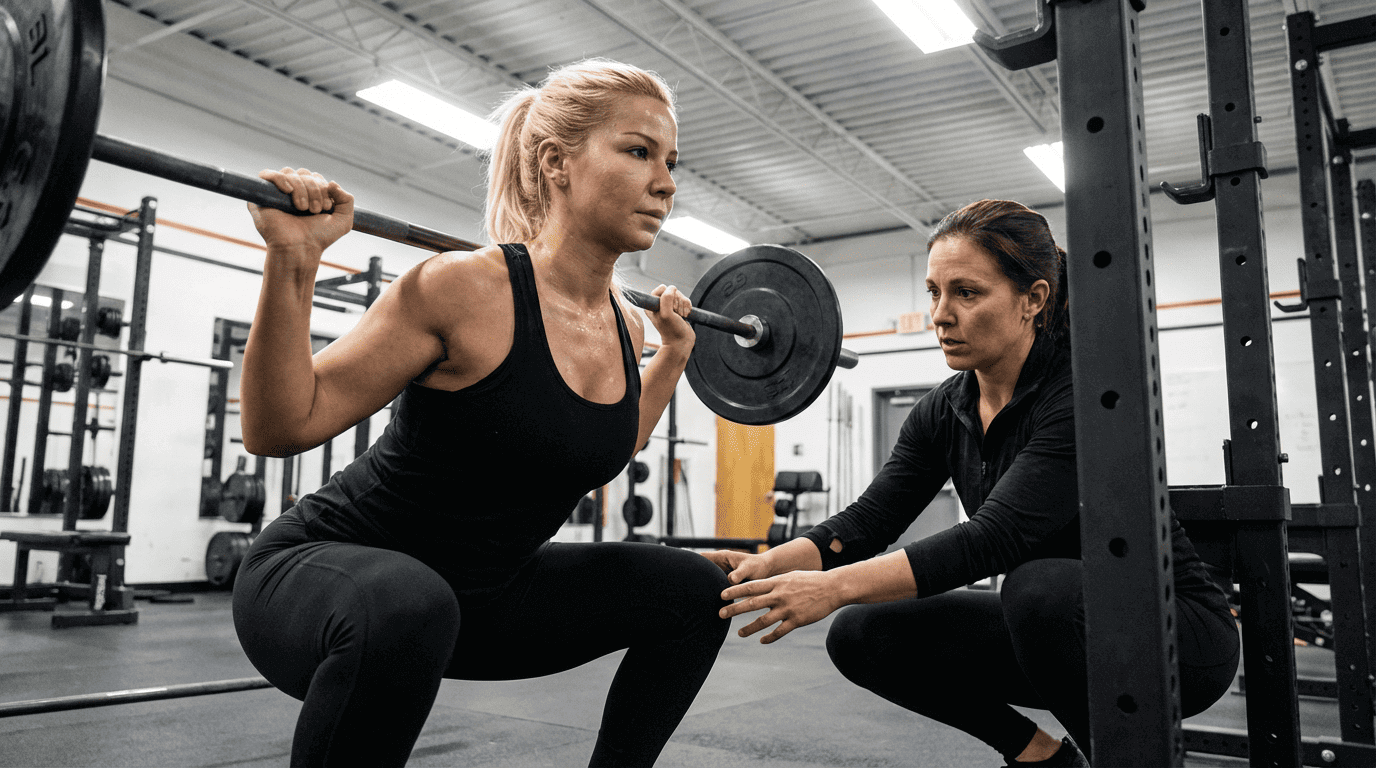
Squats
Bad Form Signal: Knees caving in or heels lifting off the ground.
Fix: Drive your knees slightly outward and keep your weight in your heels. Think about spreading the floor apart with your feet.
Deadlifts
Bad Form Signal: Feeling strain in the lower back.
Fix: Keep your back neutral, hinge at the hips, and bring the bar close to your shins. Your glutes and hamstrings should drive the lift, not your spine.
Pushups
Bad Form Signal: Elbows flaring wide or collapsing through the shoulders.
Fix: Keep your core tight, elbows tucked at 45 degrees, and push the floor away. Quality over quantity always.
Planks
Bad Form Signal: Arching in the lower back or shoulders creeping up.
Fix: Pull your belly button toward your spine, tuck your pelvis slightly, and keep your head in line with your body.
Lunges
Bad Form Signal: Losing balance or feeling pain in the front knee.
Fix: Take a wider stance, keep your chest upright, and push through your front heel instead of your toes.
When you slow down and focus on control, every rep becomes an opportunity to improve.
Hormonal Phases and Movement Awareness
Your form and energy naturally shift with your menstrual cycle. Knowing what to expect helps you adapt your training instead of fighting it.
During the follicular phase, estrogen rises, improving coordination and endurance. This is the best time for challenging workouts or learning new skills.
During ovulation, estrogen and testosterone peak, making you stronger and more confident. But because joint laxity increases, stability becomes extra important. Warm up properly and focus on controlled movements.
In the luteal phase, progesterone takes over, which can make you feel bloated or tired. Your body’s feedback is louder here, soreness, stiffness, or irritability mean it’s time to pull back on volume and focus on slower, mindful form.
During your menstrual phase, energy dips, and recovery becomes priority. I often tell clients to use this phase for mobility, stretching, and light resistance work. It’s the perfect time to reconnect with body awareness and refine technique.
Understanding these hormonal shifts makes training more sustainable. Instead of forcing progress, you flow with your biology.
When to Stop and Reset
There’s a fine line between working hard and working against your body. If something feels wrong, it usually is.
Here’s when to stop immediately:
- You feel sharp or stabbing pain.
- Your balance is off or you lose control mid-rep.
- You can’t maintain steady breathing.
- The exercise feels disconnected from the target muscle.
When that happens, lower the weight, correct your alignment, and reset. There’s no shame in taking a step back. I’ve done it hundreds of times, and every reset has made me stronger.
Form mastery isn’t about perfection, it’s about awareness. The women who make the most progress are the ones who know when to pause, reassess, and come back with intention.
FAQs
1. How do I know if my form is wrong during workouts?
If you feel pain in joints or fatigue in the wrong muscles, your form is likely off. Use mirrors, videos, or a coach’s guidance to refine your movement.
2. Why does an exercise feel wrong even when it looks correct?
Visual alignment can be misleading. Often, the issue lies in muscle activation or breathing. Trust how the movement feels internally, not just how it looks.
3. What should I feel in the right muscles during female fitness exercises?
You should feel steady tension in the target muscle and stability in your joints. If you feel pressure or strain elsewhere, adjust your position and core engagement.
Final Thoughts
Learning how to spot bad form using female fitness signals changed my entire approach to training. I stopped chasing exhaustion and started chasing connections. Every workout became a conversation between me and my body instead of a battle against it.
Your body is incredibly intelligent. It gives feedback through sensations, fatigue, and even your breathing patterns. When you learn to interpret those signals, you stop guessing and start growing.
Now, when I train, I’m not focused on how much I can lift but how well I can move. That shift has made me stronger, more confident, and injury-free for years.
The secret to lasting progress isn’t just discipline, it’s awareness. When you listen to your body, it will always guide you toward better strength, alignment, and balance.