Table of Contents
I’ll never forget the first time I actually felt my back working during a pull workout. Before that day, my pull sessions always felt like arm workouts in disguise. I’d leave with burning biceps but not much to show for it in my back.
Then one day, my coach told me to slow everything down. She said, “Stop chasing reps, start controlling them.” I didn’t think something that simple would matter, but by the end of that session, my muscles were on fire in the best way.
That’s when I realized the real secret wasn’t about lifting heavier. It was about learning control. Once I started training pull days using female fitness control, everything changed. My back muscles finally responded, my grip improved, and I felt more connected to my body than ever before.
Why Pull Days Feel So Challenging for Women
Most women I’ve trained or spoken to say the same thing: “Pull days are harder than push days.” It’s true, and it’s not because women are weaker. It’s because of how our muscles naturally activate.
We use our front-facing muscles constantly. Typing, cooking, lifting groceries, even holding our phones these all work the chest and shoulders. Our back muscles, on the other hand, are underused and often underdeveloped. So when it’s time to pull, our arms take over.
Hormones also play a role. During certain parts of the menstrual cycle, especially the luteal phase, coordination and strength can dip slightly. I’ve noticed this both personally and with my clients. Pull exercises that feel effortless one week can feel ten times harder the next.
But that’s not a weakness. It’s just a signal from your body that you need more control, patience, and awareness. Once you learn how to adapt your training to your hormones, even your toughest pull days start to feel purposeful instead of frustrating.
The Science of Control and Muscle Activation
Control isn’t just about slowing down. It’s about creating tension where it matters. When you move slowly and intentionally, your brain sends stronger signals to your muscles. This communication builds what’s called the mind-muscle connection.
For women, this connection is essential. Our bodies are designed for endurance and coordination, not constant high intensity force. When I started emphasizing control, I could finally feel my lats engage instead of letting my arms dominate every rep.
There’s actual science behind this. Studies show that slowing down the eccentric phase, the lowering part of a rep, can increase muscle activation by nearly 40 percent. That means better strength, more definition, and improved form all without needing to lift heavier weights.
Control also teaches patience, something I didn’t realize my training was missing. It forced me to tune in instead of zone out. Every rep became an opportunity to listen to what my body was doing, not just push it harder.
Common Pull Day Mistakes Women Make
I’ve been guilty of every one of these mistakes, and they’re incredibly common:
- Pulling with the arms, not the back. This happens when you don’t engage your lats before pulling. The arms take over and your back gets minimal work.
- Using momentum. Swinging through reps might make it easier, but it cheats your muscles of growth. True strength comes from control, not speed.
- Neglecting grip strength. A weak grip limits how much tension your back can create. Strengthening it is key to mastering pull movements.
- Ignoring breathing. Breath control stabilizes your core and keeps tension where it belongs. Inhale as you lower, exhale as you pull.
Once I corrected these habits, my progress skyrocketed. My form improved, my posture became better, and for the first time, my pull days didn’t feel like a chore they felt empowering.
How to Build Female Fitness Control in Pull Workouts
Building control doesn’t mean reinventing your workout. It’s about being mindful during every rep.
Here’s how I teach it:
- Set your intention. Before you even pick up a weight, remind yourself what muscles you’re targeting. This helps your brain activate those muscles faster.
- Focus on the stretch. The lowering phase is where real strength is built. Count three slow seconds down on each rep.
- Lead with your elbows. Imagine driving them toward your ribs instead of just pulling your hands back.
- Keep tension constant. Never let your muscles relax fully during a set. Stay engaged from start to finish.
It takes practice, but the control you develop will translate into every movement you do from lifting groceries to improving posture.
Pull Day Tempo: Slow Down to Strengthen
Tempo is one of the most underrated training tools for women. Once I learned how to manipulate tempo, every workout became more effective.
A simple tempo like 3-1-1-0 can make a massive difference.
Here’s what it means:
- 3 seconds to lower the weight
- 1 second pause at the bottom
- 1 second to pull back up
- 0 seconds rest at the top
It sounds simple, but it’s not easy. You’ll feel your muscles working in a whole new way. That’s because time under tension is one of the biggest drivers of strength and muscle growth.
If you’ve ever wondered why you’re not seeing progress even though you’re consistent, your tempo might be the missing link. Slowing down amplifies results.
Hormones and Pull Performance: How Cycle Syncing Helps
When I started syncing my workouts to my cycle, my pull days became smoother and more predictable. Instead of forcing myself through tough sessions during low-energy phases, I adjusted based on how my body felt.
Here’s how I usually structure my pull days according to hormonal phases:
| Cycle Phase | Hormone Pattern | Pull Day Focus | Tempo Suggestion |
| Menstrual | Low estrogen and progesterone | Light resistance and mobility | 4-2-1-1 |
| Follicular | Rising estrogen | Strength and performance | 2-0-1-0 |
| Ovulatory | Peak estrogen and testosterone | Heavy compound lifts | 3-1-1-0 |
| Luteal | Rising progesterone, lower energy | Controlled form and stability | 4-2-1-0 |
This rhythm lets you train smarter, not harder. It keeps you progressing while respecting natural fluctuations in energy and recovery.
Cycle syncing doesn’t mean limiting yourself. It means learning when to push and when to pace.
My Personal Experience with Controlled Pull Training
When I began using control techniques on pull days, I thought it would just help me lift better. But it ended up changing how I viewed my entire training philosophy.
I became more patient, more aware, and more connected to my body. My progress stopped depending on good gym days and started depending on how well I could listen to my body’s cues.
I remember one specific moment a set of slow, controlled dumbbell rows when I felt my lats fully engage for the first time. It wasn’t a heavy weight, but the connection was powerful. I realized strength isn’t just about power. It’s about precision.
Now, every pull day is an opportunity to practice that connection. It’s not just a workout it’s a form of self-awareness.
Structuring a Balanced Pull Day for Women
Here’s an example of how I design a female focused pull day routine that emphasizes control and strength:
Warm-Up (10 minutes)
- Scapular pull-ups: 2 sets of 10
- Band pull-aparts: 2 sets of 20
- Cat-cow stretches and thoracic rotations
Main Lifts
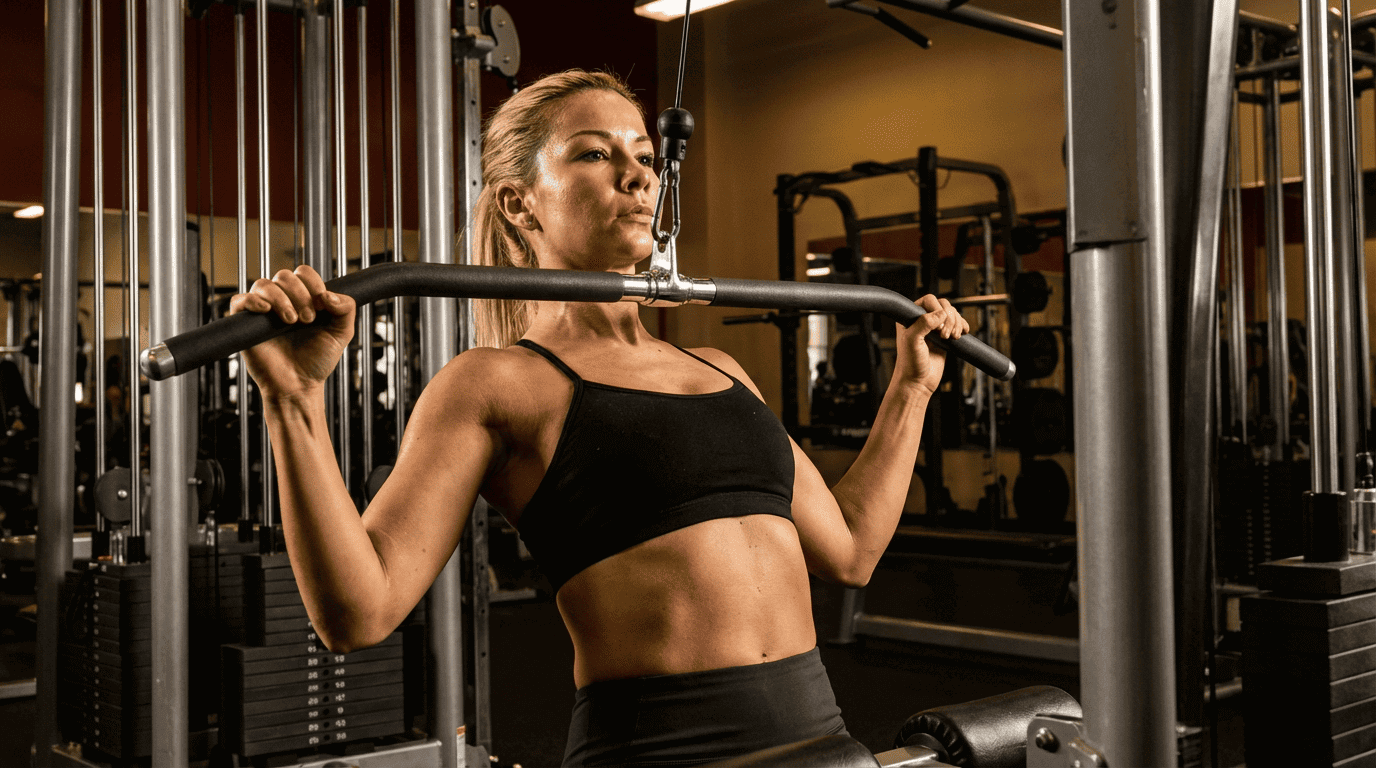
- Lat pulldown: 3 sets of 10 (3-1-1-0 tempo)
- Dumbbell rows: 3 sets of 12 per arm (pause and squeeze at the top)
- Assisted pull-ups or banded pull-ups: 3 sets of 8 (slow descent)
Accessory Work
- Face pulls: 3 sets of 15
- Banded straight-arm pulldowns: 2 sets of 20
- Hammer curls: 3 sets of 12 for grip strength
Cool Down
- Child’s pose with deep breathing
- Lat and upper back stretches
- Shoulder mobility flow
This workout isn’t about exhaustion. It’s about execution. Every rep should feel intentional, controlled, and grounded.
Tools That Help Build Better Control
These tools made a massive difference in how I track my progress and refine my form:
- Strong App: Logs reps, tempo, and progress over time
- Metronome App: Helps maintain consistent tempo
- Resistance Bands: Improve activation before heavy lifts
- Whoop or Apple Watch: Tracks recovery and readiness
- Cycle Syncing Apps (Clue or Flo): Helps plan training intensity around hormonal changes
These tools bridge the gap between training intuitively and training strategically.
FAQs
1. How do I train pull days using control instead of momentum?
Start by slowing down your reps and focusing on feeling the back muscles contract. Use lighter weights until you can perform each movement with precision.
2. Why do my pull exercises feel harder than push workouts?
Because the back muscles are often underdeveloped and less activated in daily movement. Over time, controlled training helps balance strength and stability.
3. What’s the best way to improve back activation?
Incorporate pre-activation drills like band pull-aparts, scapular pull-ups, and isometric holds before your main lifts. Focus on form, not load.
Final Thoughts
Learning how to train pull days using female fitness control didn’t just improve my strength. It completely reshaped my mindset around training.
When I slowed down and focused on control, I discovered muscles I hadn’t truly used before. My back grew stronger, my posture improved, and my workouts became more intentional and rewarding.
It’s easy to chase numbers and quick results, but real transformation happens when you master control. Every rep becomes a conversation with your body. You begin to trust it, listen to it, and move with confidence instead of force.
If your pull days have felt like a struggle, give this approach a try. Track your tempo, align with your cycle, and focus on controlled, meaningful movement.
True strength isn’t built by speed. It’s built through awareness, discipline, and consistency. When you learn to train with control, you’re not just building muscle you’re building mastery.